
The newly released Skills England Sector Skills Needs Assessment: Construction report outlines the shifting workforce landscape over the next decade. Driven by infrastructure pipelines and the government’s target to build 1.5 million homes, the construction and fit-out sectors face an unprecedented demand for qualified, skilled labor.
Here is a general summary of the key findings and what they mean for NAS members:
1. The Scale of the Labor Shortfall
-
Immediate Shortages: The Department for Business and Trade (DBT) estimates an aggregate construction labor shortage of between 201,000 and 755,000 workers by 2030.
-
The 10-Year Outlook: Between 2025 and 2035, employment demand across the sector’s 30 priority occupations is projected to expand by 493,000 jobs (a 26% increase).
-
Replacement Demand: In addition to new jobs, an estimated 595,000 workers will leave these priority occupations due to retirement or career changes and must be replaced.
-
The Bottom Line: The wider construction sector must recruit and train 1,088,000 new workers by 2035 to meet baseline demand.
2. Critical Demand for Carpenters and Joiners
-
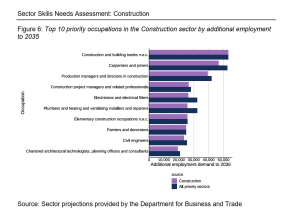
High Priority Status: Out of 30 core occupations analyzed, Carpenters and joiners represent the second-highest specific demand for additional employment to 2035, as illustrated in the report’s chart, image_4b0721.png.
-
Cross-Sector Competition: This role faces intense recruitment pressure because demand heavily overlaps with other priority sectors outside of core construction, making it harder to attract and retain talent.
-
Focus on Trade Skills: Unlike many other industries where higher education dominates, 59% of the projected job growth requires workers with Level 2 or Level 3 qualifications. The primary skills shortage is in practical, on-the-ground trades.
3. Training Pipelines and Apprenticeships
-
Apprenticeship Surge: Traditional training routes remain the lifeblood of the industry. Achievements in Level 2/3 Building and Construction apprenticeships grew by a staggering 60% between the 2021/22 and 2023/24 academic years.
-
High Conversion Rates: Building and Construction Level 2/3 apprenticeships boast a 70% conversion rate, meaning nearly three-quarters of education leavers from this route successfully transition straight into priority sector roles.
-
Alternative Routes: Newer training pathways are also scaling up, with construction Skills Bootcamps seeing achievements grow from 2,000 in 2022/23 to 4,700 in 2023/24.
The Takeaway for Fit-Out Contractors
This data confirms that the competition for qualified tradespeople will remain fierce for the foreseeable future. As the industry continues to navigate tightening competence standards under the Building Safety Act 2022, securing and upskling your workforce through certified pathways (such as apprenticeships and verified card schemes) is crucial to safeguarding your future project delivery.
The full report and methodology can be reviewed in detail within the sna_construction.pdf document.