The Construction Leadership Council (CLC), in collaboration with the Building Safety Regulator (BSR), has officially issued a critical June 2026 update to its Building Control Guidance Suite for Higher-Risk Buildings.
As fit-out contractors and specialist installers, staying compliant with these stringent guidelines is vital to prevent major project delays, as the BSR heavily scrutinises site competence and technical submissions.
What is a Higher-Risk Building (HRB)?
An HRB is defined as a building in England that is at least 18 metres high or has at least 7 storeys, and:
-
Contains 2 or more residential units, OR
-
Is a hospital or a care home.
Why This Matters: Addressing BSR Rejections
Feedback from the BSR indicates that while the quality of submissions is improving, poorly prepared documentation remains a primary cause of application rejections.
To combat this and speed up Regulator response times, the latest June 4, 2026 update introduces two brand-new, highly detailed guidance notes focusing on core problem areas. Submissions must clearly narrate your technical design approach and fully evidence all fire and structural risk assessments.
Key Updates in the June 2026 Guidance Suite
The complete guidance suite now features 11 specific Guidance Notes to shepherd dutyholders through the mandatory 3-gateway regime (Planning, Building Control Approval, and Completion). The newest additions include:
-
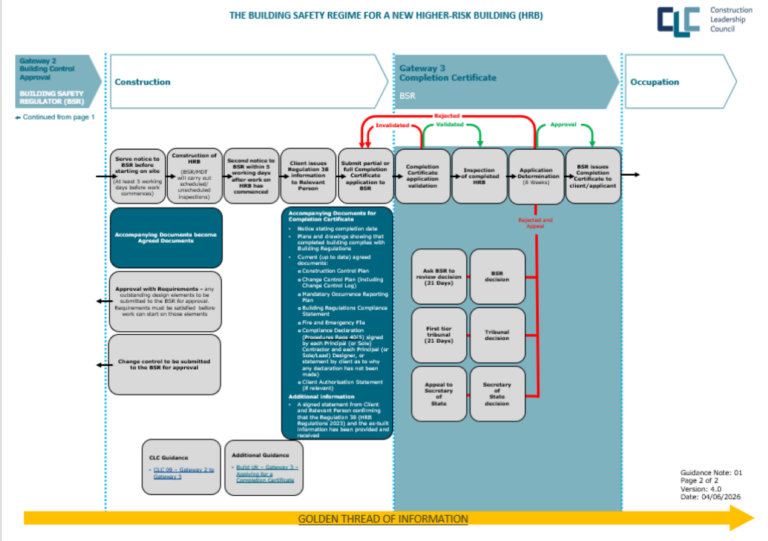
Guidance Note 01 (Updated): Features a revised summary process map outlining the entire end-to-end Building Control regime.
-
Guidance Note 10 (NEW – Fire and Emergency File): Clear instructions on the preparation, development, and long-term management of the Fire and Emergency File (FEF), complete with structural examples.
-
Guidance Note 11 (NEW – Building Regulations Compliance Statement): Outlines the required qualitative content and presentation for the Compliance Statement (BRCS), including sample extracts.
Broad Application: While written primarily for new builds, the CLC notes that these application principles are common across all building works. This means the suite is highly useful for fit-out or refurbishment works taking place in existing HRBs (particularly Category A and select Category B works).
Maintaining the “Golden Thread”
As shown in the updated process map below, maintaining a continuous Golden Thread of Information is mandatory from the initial site notices up until the final handover.
Before a building can transition to the Occupation phase, it must pass through Gateway 3 (Completion Certificate). A mistake or missing document in your Fire and Emergency File or Compliance Statement at this stage will cause the BSR to invalidate or reject the application, triggering a costly 21-day review or tribunal appeals process.
Read the Full, Updated CLC Guidance Suite Here